Interactive · 1 question

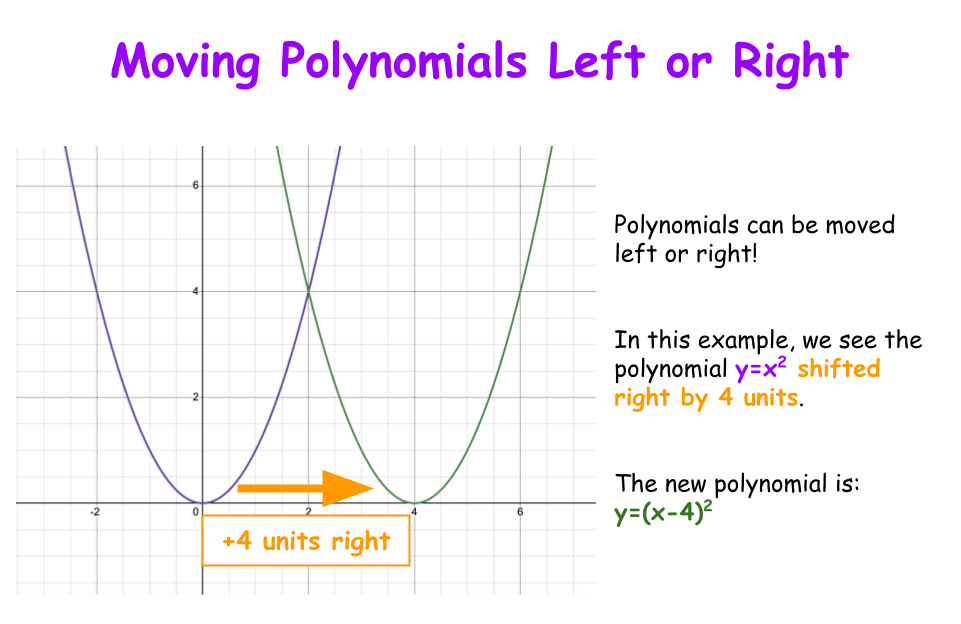
The next lesson in polynomial transformations is about moving polynomials right and left.
In the previous lesson, we learned about moving polynomials vertically, up and down. We learned that the vertex form of the quadratic function shows us how to move quadratics. The vertex form of quadratics is,
The value affects the translation up and down. The value, which we'll focus on in this lesson, affects the translation right or left.
Let's review the characteristics of parent quadratic functions.
-
Vertex at
-
Function goes through and
-
Parabola opens upwards
-
Standard form:
Translating Quadratics Right or Left
Translating quadratics horizontally is very similar to translating quadratics vertically, but there's a key difference: signs! If you look back to the vertex form of the quadratic equation, you'll notice that there is a negative sign in front of the .
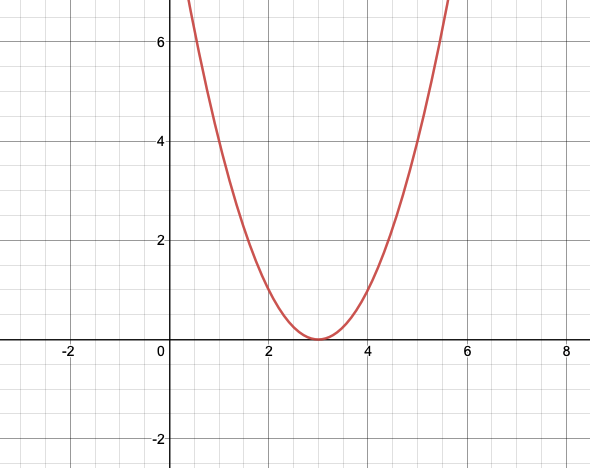
Say we want to translate the parent function of a quadratic by units to the right. That means that . If we plug this into the equation, we get,
This may seem confusing - it feels like the negative should indicate that the function is moving three units to the left, but that is not the case!
The function graphed looks like:
Made using Desmos
As we can see, the function was shifted three units to the right!
Example
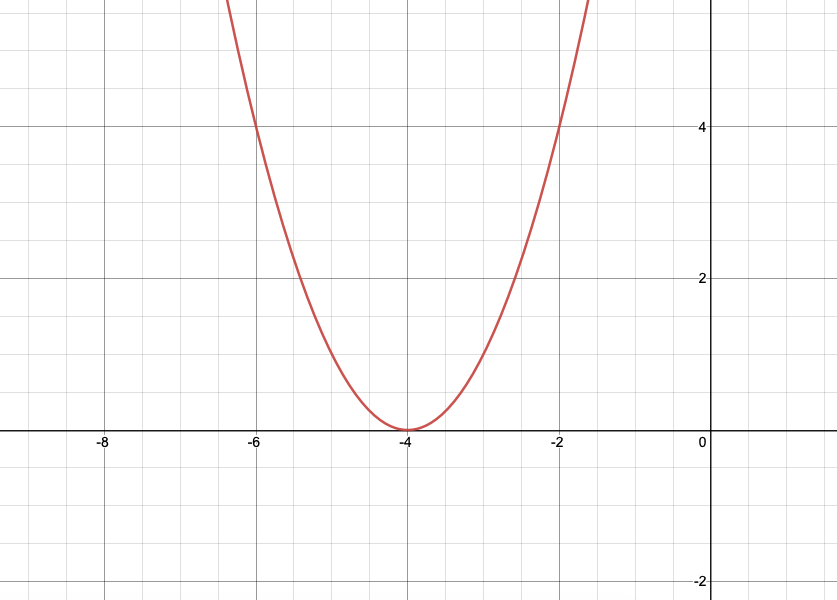
Graph the function .
First, we need to figure out what is. We know that the vertex form of the quadratic function is . Our problem has and , so we know there are no dilations and no vertical translations. But, we know there is a horizontal translation, as there is some value of .
Your first instinct may be to say that , but it's important to watch your signs! For this problem, .
The graph looks like:
Made using Desmos
Practice
Identify the transformations from the parent function for: