Apakah itu perubahan?

Illustrated · 1 min

We know that the standard form of a quadratic function is ax2+bx+c=0ax^2+bx+c=0, where aa, bb, and cc are coefficients. We know that the cc value dictates the vertex of the parabola, and aa tells you the opening direction and the stretching/compression of the parabola. We can manipulate these values to change how we want our parabola to look.

We can use this idea when considering polynomial transformations!

Polynomial Transformation

A polynomial transformation is when we alter a basic function to change the way it looks. Essentially, we are translating the function to a different position on a coordinate plane.

Let's look at an example.

The following is a graph of y=x2y=x^2.

Graph in red of y=x^2

Made using Desmos

We can move this function to the left! The equation is y=(x+2)2y=(x+2)^2.

Graph in red of y=(x+2)^2

Made using Desmos

Let's think about what would happen if we wanted to move this function up! It would look like the next graph! The equation is

Graph in red of y=(x+2)^2 +3

Made using Desmos

So, as you can tell, you can move around your function on a graph using different transformations!

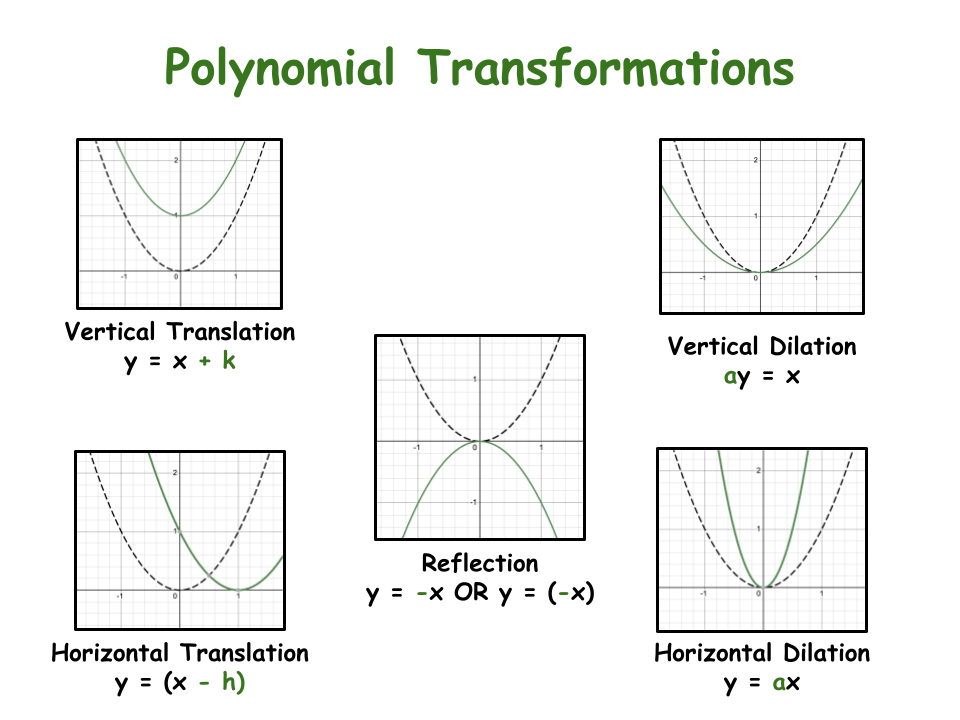
We can do the following transformations:

The following lessons will consider these transformations in-depth!

Video

(Video) Transformations on Polynomials

by Kyle Hall

In this video by Kyle Hall, you will learn about a few different polynomial transformations together.

Use this video as an introduction to polynomial transformations, but don't spend too much time on the details! We will break down the individual concepts in the following lessons.

Illustrated · 1 min

Polynomials Transformations

Polynomials are expressions made up of terms with variables raised to powers, like x2x^2 or 3x33x^3. A polynomial function is a graph that shows how these expressions change as you plug in different values for xx. But sometimes, we don't just want the regular graph of a polynomial — we want to shift, stretch, or flip it. This is where polynomial transformations come in!

Polynomials Transformations

Made using Desmos

When we change a polynomial, we can move its graph up, down, left, or right. These changes are called translations. You can also dilate a graph vertically (stretch) or horizontally (compress). Lastly, if you multiply the entire function by a negative number, it flips or reflects the graph upside down. Similarly, changing the power of xx can change the shape of the graph, like when you move from a quadratic function to a cubic function.

Understanding how these transformations work helps you predict how the graph of a polynomial will look just by looking at its equation. In the next lesson, we’ll explore more specific examples of these transformations with different polynomials!

Type a concept, like “slope” or “photosynthesis”.

↑ ↓ to choose · Enter to openSearch explanations and problems