Mengubah satu grafik menjadi yang lain

Before this, knowBergerak ke kanan atau ke kiriCermin (mencerminkan tentang y-aksis)Merentangkan secara vertikal

Illustrated · 1 min

So far, we have learned about many different polynomial transformations, including vertical shifts, horizontal shifts, vertical reflections, and horizontal reflections. So far, we have learned about the individual transformations, but we can combine multiple transformations into one polynomial!

There are a couple of transformations which you haven't learned yet. Those would be the dilations or stretches. These are vertical stretches, vertical compressions, horizontal stretches, and horizontal compressions. Stretching or compressing by a factor is indicated in a polynomial equation by multiplying the xx value by an integer or fraction value.

If we have the equation y=3(x+2)3−1y=3(x+2)^3-1, we can see that there are multiple transformations applied to the parent function, y=x3y=x^3. There is a dilation, a horizontal translation, and a vertical translation here.

Let's start with the parent function, y=x3y=x^3.

Graph of y=x^3

Made using Desmos

From here, let's apply the dilation by a factor of 33, giving us the intermediate equation, y=3x3y=3x^3

Graph of y=3x^3

Made using Desmos

Next, we will apply the transformation of the horizontal translation, but make sure you apply it to your intermediate equation!

Here is a graph of y=3(x+2)3y=3(x+2)^3.

Graph of y=3(x+2)^3

Made using Desmos

We're almost there! We'll now apply the vertical translation to our intermediate equation, giving us the final equation, y=3(x+2)3−1y=3(x+2)^3 -1.

Graph of y=3(x+2)^3 -1

Made using Desmos

As you can see, we worked step-by-step to incorporate the individual transformations in order to get from our parent function, y=x3y=x^3, to our final function, y=3(x+2)3−1y=3(x+2)^3 -1.

Illustrated · 1 min

Multiple Polynomial Transformations

Now that you’ve learned how to move and flip polynomials one way at a time, it’s time to put it all together! Sometimes, a polynomial graph gets transformed in more than one way. That means it might shift up, flip upside down, and move left, all at once!

Multiple Polynomial Transformations
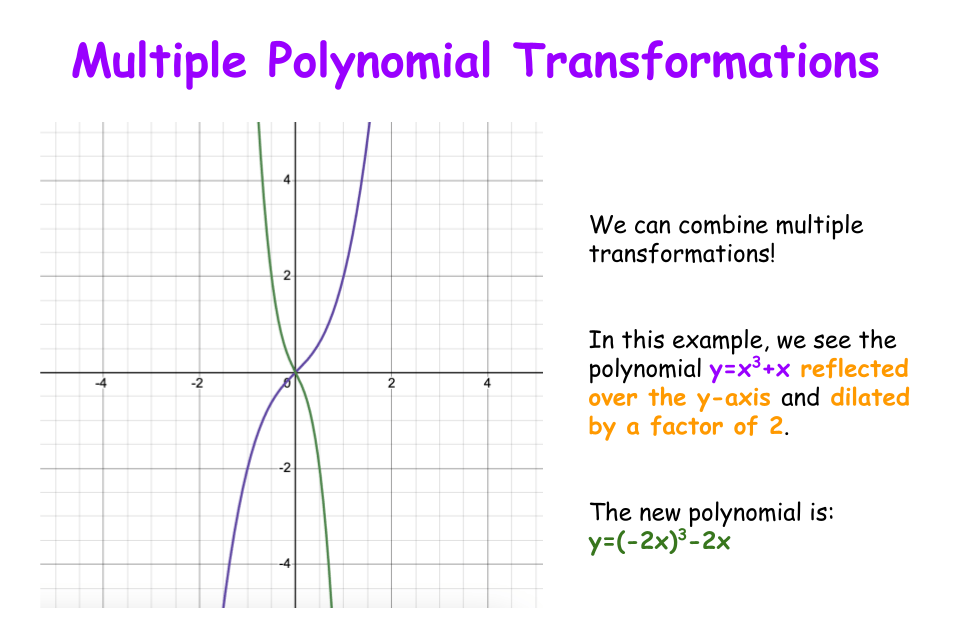
We can combine multiple transformations!


In this example, we see the polynomial y=x3+x reflected over the y-axis and dilated by a factor of 2.


The new polynomial is: y=(-2x)3-2x

Made using Desmos

Let's look at the above example. The original polynomial graph in purple is of y=x3+xy=x^3 + x. Let's think about what happens if we transform it into the polynomial in green, y=(−2x)3−2xy=(-2x)^3-2x. First, the polynomial is reflected over the yy-axis. Then, the polynomial is dilated by a factor of 22.

The order you do the transformations matters sometimes, but the graph still ends up in the same spot. A good rule is: handle what’s inside the parentheses first (left/right), then reflect or stretch, and finally move up or down.

When doing multiple transformations, take your time and do one change at a time. You’ll be surprised how easy it becomes with practice.

Video

(Video) Transforming One Polynomial Graph into Another

by Anusha Rahman

In this lesson by Anusha Rahman, you will learn how to transform one polynomial graph into another.

Summary

We’ve learned briefly about polynomials and their transformations - shifts, stretches, and reflections. These transformations modify the graph. Always look for key features like the vertex and the roots to guide you in identifying and expressing the transformation.

Type a concept, like “slope” or “photosynthesis”.

↑ ↓ to choose · Enter to openSearch explanations and problems