Carbono -Importância para a vida terrestre

Interactive · 1 question

Carbon (Biology)

Carbon is known as the backbone of life. It's the second most abundant element in living things. The unique properties of carbon are what allows the four types of macromolecule to exist.

A diagram of a carbon atom showing its nucleus and electron cloud

Image source: By Deena Hauze

This is the sixth element on the periodic table, so we know it has six electrons. Carbon has four valence (outer) electrons, six protons, and six neutrons. Recall that electrons are used to form chemical bonds. Carbon forms four covalent bonds with hydrogen, oxygen, phosphorus, nitrogen, and many others elements to make the molecules of life.

But wait, there's more. Carbon can even form bonds with itself. Now, that might not seem that remarkable, but it is actually one of the key reasons we're alive. Carbon can form single bonds, double bonds, and triple bonds with another atom, including itself.

Carbon can form different bonds with hydrogen to create other compounds. Some examples are ethane, ethene, and ethyne.

Image source: By Deena Hauze

This unique bonding feature of carbon allows it to form chains, rings, and complex structures. Some of these complex structures are macromolecules like proteins, carbohydrates, and nucleic acids.

Diagram showing the chemical structure of glucose

Image source: By Blausen.com staff (2014) "Medical gallery of Blausen Medical 2014" CC BY 3.0, via Wikimedia Commons
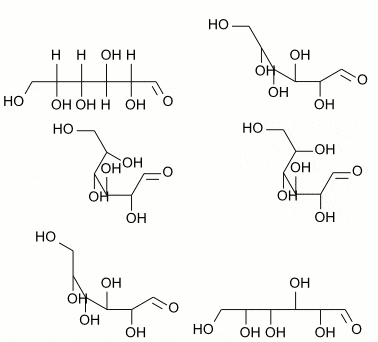
Animated diagram of the structure of glucose. It can be drawn either as a straight line or a ring.

Glucose can be drawn as a straight chain for clarity, but it actually is a ring.

Image source: By Zephyris at the English language Wikipedia CC BY-SA 3.0, via Wikimedia Commons

Which of the following structures can carbon not form?

Choose one answer

Illustrated · 1 min

Why Is Carbon so Important?

Carbon has a central role in the maintenance of life on Earth. Carbon can be found on the Periodic Table of Elements, as shown below:

Carbon has 6 protons, 6 neutrons, and a total of 6 electrons. 4 of those electrons are valence electrons. That means they are available for bonding.

Image source: By Hannah Bonville et al.

Because a carbon atom has four valence electrons (as shown in the image above), it is able to form four covalent bonds. These bonds can be with a variety of other atoms, including other carbon atoms. This makes it an important building block for complex molecules.

The bonds can be single, double, or triple bonds, as shown in the examples below.

Because of its four valence electrons, carbon can form single, double, or triple bonds.

Image source: By Hannah Bonville

Because a single carbon atom can form up to four covalent bonds, carbon is in a ton of biological molecules. As shown in the image above, these molecules can be rings, chains, or branched chains. There's a huge variety of molecule shapes and sizes when it comes to carbon.

Compounds that contain carbon are called organic compounds. Organic compounds typically have long carbon chains or rings.

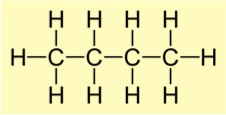
This image shows the chemical structure of C(4)H(10).

This is an example of an organic compound. It consists of a long carbon chain. The name of this compound is butane. It is a type of fuel. \\ Image source: By Hannah Bonville

In biology, we focus on four types of macromolecules—large molecules that are necessary for life. These include lipids (fats), proteins, nucleic acids, and carbohydrates. All of these molecules are organic, meaning they all contain carbon.

Carbon Cycle

Aside from carbon's role in the formation of organic compounds, it is involved in two processes that are absolutely essential to life on Earth: cellular respiration and photosynthesis.

Specifically, carbon dioxide is involved in both processes.

There are tutorials for these topics, so we'll keep the details of their chemical reactions brief here:

Cellular respiration and photosynthesis help cycle carbon throughout the atmosphere.

Image source: By Bvelevski CC BY-SA 4.0, via Wikimedia Commons

So, the oxygen (O2O_2) you breathe in is dependent on how much carbon dioxide (CO2CO_2) plants take in. Carbon dioxide and oxygen are cycled back and forth in the carbon cycle.

Key Vocabulary:

  1. Carbon
  2. Organic compounds
  3. Carbon cycle

Video

(Video) Carbon and Macromolecules

by Science With Mr J

The reason why carbon is essential for life is because it makes up so many different molecules. It can do this because of its great ability to form bonds with other atoms. In this video, you will see examples of how a simple change in structure can result in a different molecule. Monomers and macromolecules are also introduced.

Type a concept, like “slope” or “photosynthesis”.

↑ ↓ to choose · Enter to openSearch explanations and problems