Proteinas

Before this, knowMonomeros e polimeros

Illustrated · 2 min

Structure of Amino Acids

Proteins are complex polymers that contain carbon, hydrogen, nitrogen, and oxygen. They are very large macromolecules made of amino acid monomers. Amino acids are molecules with a carboxyl group (−COOH-COOH), an amino group (−NH2-NH_2), and an R group. The R group is pretty much a placeholder in a chemical structure. It shows that there is some unique group on the molecule.

An amino acid consists of three major parts: amino group, R group, and carboxyl group.

Image source: By Gabi Slizewska

The R group attached to the carbon is the tag that lets us tell the difference between amino acids. Some R groups are polar, some are non-polar, some are huge ring structures, and others are tiny. There are more than 20 possible R groups. Therefore, there are more than 20 types of amino acids.

There are nine essential amino acids. They are histidine, isoleucine, leucine, lysine, methionine, phenylalanine, threonine, tryptophan, and valine. Us humans cannot produce these on our own, so we need to get them from food. That's why they're called essential.

The rest are considered non-essential. That's because our bodies are able to synthesize them from the essential amino acids and other molecules.

The twenty one amino acids. Positively charged amino acids are arginine, histidine, and lysine. Negatively charged amino acids are aspartic acid and glutamic acid. Uncharged amino acids are serine, threonine, asparagine, and glutamine. The special cases are cysteine, selenocysteine, glycine, and proline. Hydrophobic amino acids are alanine, valine isoleucine, leucine, methionine, phenylalanine, tyrosine, and tryptophan.

Image source: By Bert Hubert CC BY-SA 4.0, via Wikimedia Commons

These amino acids are joined together by peptide bonds to form polypeptides. A peptide bond is a covalent bond between the amino group of one amino acid and the carboxyl group of a different amino acid. The formation of this bond releases a molecule of water.

The formation of a peptide bond between two amino acids.

Image source: By GYassineMrabetTalk✉ [Public domain], via Wikimedia Commons

Because peptide bonds only occur between the carboxyl and amino groups of amino acids, the R group doesn't influence the bond formation. This means that any amino acid can have a peptide bond to any other amino acid. The arrangement of amino acids in a polypeptide is dictated by DNA.

To really understand proteins, we need to look at the four levels of structure, as shown below.

Primary structure of a protein is a sequence of amino acids. Secondary structure is hydrogen bonding of the peptide backbone, which causes chains to fold. Tertiary structure is the three dimensional folding pattern due to side chain interactions. Quaternary structure is found in proteins which consist of more than one amino acid chain.

Protein structure

Image source: By CNX OpenStax CC BY 4.0, via Wikimedia Commons

Proteins are important in muscle contraction, transporting oxygen in the blood, and the immune system. Some proteins even regulate cell processes and others control the rate of reaction.

Vocabulary Review:\color{#8925AE}{\text{Vocabulary Review:}}

Monomer\color{#8925AE}{\text{Monomer}} : Any molecule that can react with other molecules of the same or different makeup to form a chain, or polymer

Polymer\color{#8925AE}{\text{Polymer}} : A chain of monomers made of a specific type of compound

Macromolecule\color{#8925AE}{\text{Macromolecule}} : A polymer that has a large (macro) molecular mass. There are four main types in organisms: carbohydrates, proteins, lipids, and nucleic acids

Amino Acids\color{#8925AE}{\text{Amino Acids}} : Molecules with a carboxyl group (−COOH-COOH) and an amino group (−NH2-NH_2). The building blocks of proteins

Polypeptide\color{#8925AE}{\text{Polypeptide}} : A molecule made up of peptide bonds, or covalent bonds that hold amino acids together

Protein\color{#8925AE}{\text{Protein}} : Complex polymer made of carbon, hydrogen, nitrogen, and oxygen. They are made of amino acids

Illustrated · 1 min

What Are Proteins?

Proteins are polymers formed from monomers called amino acids. They are joined together by peptide bonds. A chain of amino acids can also be called a polypeptide. (Anything with "pep" in it probably refers to a protein).

The primary protein structure is made of a chain of amino acid monomers.

Proteins are pretty much just long (sometimes incredibly long) chains of amino acids. They are represented in this image as circles. Each amino acid is joined to its neighbors by a peptide bond.

Image source: By National Human Genome Research Institute [Public domain], via Wikimedia Commons

There are 20 amino acids from which all proteins are made. Some proteins contain just a few amino acids in a chain, while other proteins are chains of thousands of amino acids. The largest known protein is titin. It's made of a chain of 33,000 amino acids.

Here are the 20 amino acids. Note that many (though not all) have names ending in -ine. All amino acids contain nitrogen.

There are 20 types of amino acids.

Image source: By CNX OpenStax CC BY 4.0, via Wikimedia Commons

All amino acids have three identical parts:

  • an amino group
  • a carboxyl group
  • a hydrogen

They only differ in their fourth part, called a functional group or R group.

In the table above, the functional groups are highlighted in blue. Note how every other part of the amino acids is always the same.

What Do Proteins Do?

Proteins are the most diverse of the four biomolecules. In fact, they perform the majority of a cell's functions. For example, proteins can catalyze (speed up) reactions as enzymes, act as signaling proteins, transport molecules, replicate DNA, respond to stimuli, and form structures within cells.

Because of their many uses, proteins form the bulk of the weight in a cell. In fact, each one of your cells is estimated to hold between one and three billion proteins.

Proteins are often not used as energy storage molecules. They are the workers of a cell. Proteins do things. They perform and carry out the functions that enable a cell to move, use energy, respond to stimuli, and everything else that keeps a cell alive. So, a high protein diet will not give you a lot of energy like carbohydrates will, but it will help your cells do their jobs throughout the day.

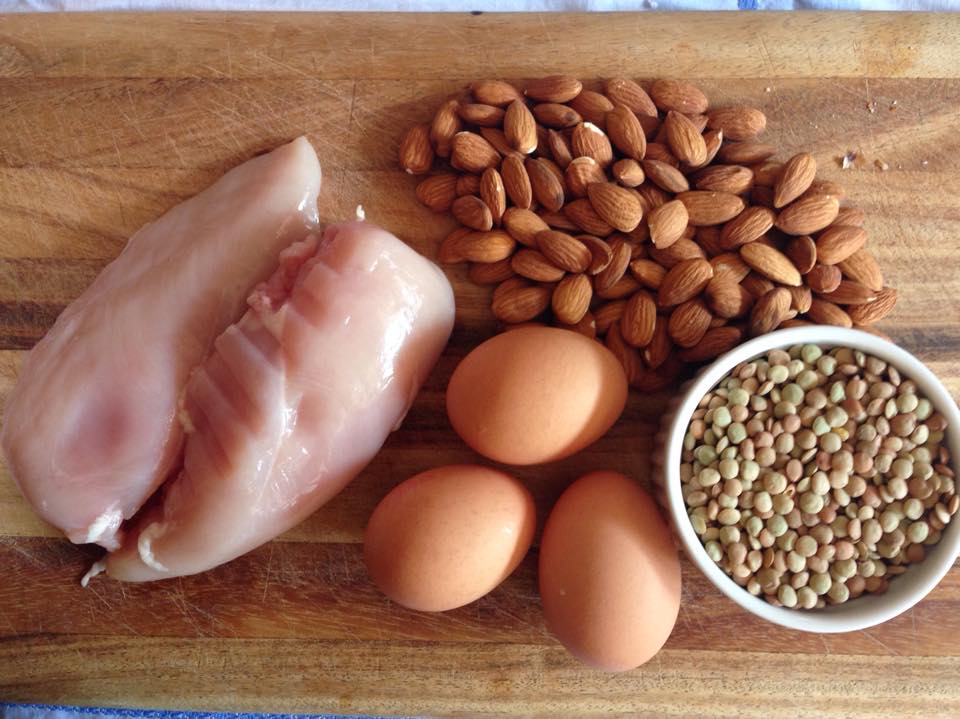
Proteins are found in foods like eggs, meats, and nuts.

You can find high amounts of protein in plant and animal sources.

Image source: By Smastronardo CC BY-SA 4.0, via Wikimedia Commons

Video

(Video) Biological Molecules

by CrashCourse

The video above explains the structure and function of proteins.

Animal products are of course a good source of protein, but there are plant-based proteins too, like peanut butter. Make sure to watch until the end to see Hank eat a delicious protein-packed sandwich.

Type a concept, like “slope” or “photosynthesis”.

↑ ↓ to choose · Enter to openSearch explanations and problems