
Video
By Valeri Natole

+1 contributors
Contributors

(Video) Nucleic Acids
by RicochetScience

This video explains the role of nucleic acids in the storage of genetic information and protein synthesis in all living things.
Video
by RicochetScience
This video explains the role of nucleic acids in the storage of genetic information and protein synthesis in all living things.
Illustrated · 1 min
Nucleic acids are macromolecules that store and transmit hereditary information (like your genes).
They are composed of monomers called nucleotides. A chain of nucleotides can also be called a polynucleotide. Remember that poly means "many", so many nucleotides put together get you a polynucleotide. This is a long word, though, so we usually just say nucleic acid. Same thing.
Linking together nucleotide monomers into a polymer is done through a polymerization reaction called dehydration synthesis. This reaction creates phosphodiester bonds by removing water (it dehydrates the molecules).

Image source: By OpenStax College CC BY 3.0, via Wikimedia Commons
Three major nucleic acids are deoxyribonucleic acid (DNA), ribonucleic acid (RNA) and adenosine triphosphate (ATP). You are going to be sick of these three molecules by the time you're done with biology, we promise.
RNA and DNA carry genetic information. This information can be used to make amino acids (proteins) later.
ATP is the primary energy molecule in a eukaryotic organism. Almost all cell processes that require energy use this nucleic acid.
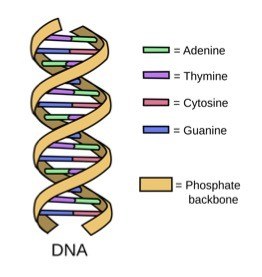
Image source: By Forluvoft [Public domain], via Wikimedia Commons
Illustrated · 1 min
Nucleic acids are polymers made from monomers called nucleotides. As shown below, nucleotides are made up of a nitrogen group, a phosphorus group, and a 5-carbon ring. Nucleotides are important in gathering and transferring chemical energy. An example that we'll learn more about later is ATP, which is often called the "molecular unit of currency".

Image source: By OpenStax College CC BY 3.0, via Wikimedia Commons
The phosphate groups form covalent bonds, while the nitrogenous bases form hydrogen bonds together. As the nucleotides link up, they form a nucleic acid.

Image source: By Madprime (talk · contribs) CC0, via Wikimedia Commons
: Any molecule that can react with other molecules of the same or different makeup to form a chain, or polymer
: A chain of monomers made of a specific type of compound
: A polymer that has a large (macro) molecular mass. There are four main types in organisms: carbohydrates, proteins, lipids, and nucleic acids
: The monomers of nucleic acids. Made up of a nitrogen group, a phosphorus group, and a 5-carbon ring
: Complex polymer that transfers energy and stores information in a cell in the form of a code. ATP, DNA, and RNA
Illustrated · 1 min
Nucleic acids are macromolecules in our bodies that are primarily responsible for heredity and information storage. They were first discovered by Friedrich Miescher, who isolated them from DNA.
Nucleic acids are made of their monomer called nucleotides. These nucleotides create polymers known as polynucleotides. The terms monomer and polymer can be confusing. It might help to think of monomers as one bead and polymers as a whole bracelet that the beads help create. Polynucleotides are chains of nucleotides connected by phosphodiester bonds.
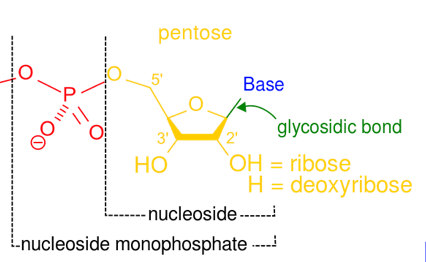
Image source: By Boris, Sjef [Public domain], via Wikimedia Commons
Nucleotides are made up of three parts:
Nucleotides join up as base pairs to make DNA (deoxyribose nucleic acids) or RNA (ribonucleic acids).
The difference between DNA and RNA is in the pentose sugar. The pentose sugar in RNA has an extra oxygen, whereas the one in DNA is deoxy, or "without oxygen". Another difference between DNA and RNA is that instead of the base thymine that's used in DNA, RNA has the base uracil. Also, DNA has a double helix whereas RNA is single-stranded. Finally, RNA can come in many forms like messenger RNA, transfer RNA, and ribosomal RNA.
Nucleotides and their unique bases create the framework for all the genetic information in a living organism. These bases bond with their complementary base pairs in DNA to form double-stranded molecules that are necessary for encoding an organism's genetic information.

