Theoretical Probability

Interactive · 2 questions

Theoretical Probability\textbf{Theoretical Probability}

Theoretical probability is just what it sounds like: the probability of an event occurring in theory. In other words, when you calculate theoretical probability, you are calculating a hypothetical or expected value. You are not calculating probability based on experimentally collected data (that would be Experimental Probability rather than Theoretical Probability).

We can calculate theoretical probability of an event, E,E, occurring using the following formula:
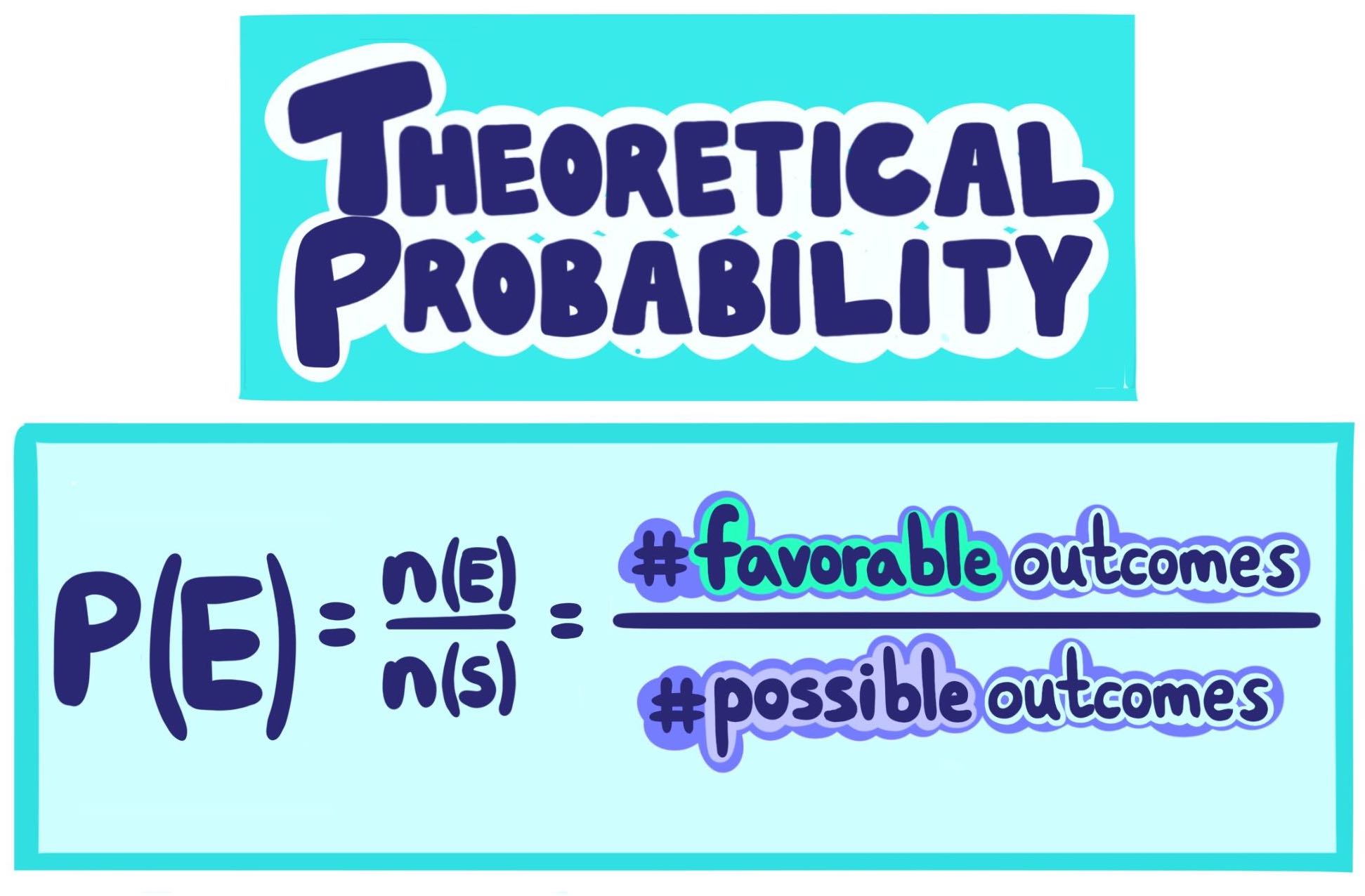
Theoretical Probability formula: P(E) = n(E)/n(S) = (number of favorable outcomes)(number of possible outcomes)

Image by Caroline Kulczycky

Here, P(E)P(E) represents the theoretical probability that event EE will happen, n(E)n(E) represents the number of times EE can occur, and n(S)n(S) represents the total number of outcomes.

Let's use this formula in an example!

marbles

Image by rawpixel.com via Pexels CC0

You have a bag with ten marbles. Half of the marbles are blue, two are purple, one is green, the rest are pink. If you reach into the bag and pull out a marble at random, what is the theoretical probability that it will be pink?

Choose one answer

Interactive · 6 questions

What is a theoretical probability?

Think of theoretical probability as a "probability on paper." It's not something you find during an experiment. You aren't looking at data or thinking about what you've observed.

To say it another way, theoretical probability is just a hypothetical value. It's not based on what has happened, but rather on what should happen if you, hypothetically, decide to do an experiment or collect data.

Picture of pencil and paper

Theoretical probability is "probability on paper." It's not based on any real-life data or experiment.

There's a pretty straightforward formula we can use to calculate theoretical probability.

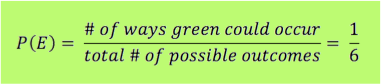
P(E) = n(E)÷n(S) = (# of times event could occur) ÷ (total # of possible outcomes)

Don't be alarmed by the parentheses and letters in the equation! I wanted to include the "fancy" math equation you might see along with the translation into regular English.

P(E)P(E) is a common abbreviation for the probability of an event, E, occurring.

So, to find the theoretical probability of an event, P(E), just divide the number of times the event E could occur by the number of all possible outcomes.

Let's practice.

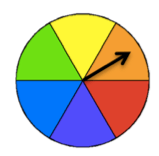
Circle (with a spinner attached to the center) divided into 6 equal sections: one yellow, one orange, one red, one purple, one blue, and one green.

What is the theoretical probability of the spinner landing on green?

Choose one answer

Read · 2 min

We live in a world which is incredibly random. Things we take for granted, like the time it takes to drive places, or the number of people in line for food, are not fixed permanently forever. They fluctuate based on unknown factors.

You use probability every day. For example, when you decide how much sleep you need, you are making a judgment about how likely it is that being tired the next day will affect you. (Admittedly, sometimes you will look over at the clock and wonder why it says 3am3\text{am} instead of 11pm11\text{pm}, but more often than not, we choose to pull an all nighter to finish a project or play games with friends till the dark hours of the morning because it's worth more to us than the problems we'll have tomorrow.)

When you make decisions like that, you are evaluating the Theoretical Probability that you will be tired tomorrow. Theoretical probabilities represent the hypothetical probability of an event occurring, but not necessarily the probability found by looking at any one set of those events which have already happened.

Theoretical probabilities are, in a certain sense, unknowable. There is no way you can know them for certain by experimentation alone. You can only find out by thinking about them in a probabilisitic way that makes assumptions about the way the world works.

This makes them different from Experimental Probabilities, which are found by doing experiments and are approximations of the "real" theoretical probabilities.

On the other hand, much of probability and statistics is based on the fact that if you do things a lot of times, then your results will eventually become so close to the theoretical probability that you can't tell the difference.

Let's take the unassuming example of a six-sided die. If you roll this die once, the probability of rolling a six is 16.\frac{1}{6}. Yet, when you roll a bunch of dice at one time −- let's say 3030 dice −- the number of sixes you roll is not necessarily going to be exactly 16\frac{1}{6} of the total. In other words, you may not roll exactly 306=5\frac{30}{6} = 5 sixes.

Why is this?

Because each event happens randomly. If you rolled 6,0006,000 dice, it is unlikely that you would roll exactly 1,0001,000 sixes, but you would probably roll somewhere in that neighborhood. Of course, it is possible that you roll 00 sixes, and 6,0006,000 ones, but this is highly unlikely. Thus, we can expect around 16\frac{1}{6} of our rolls to be sixes, but there are also a range of other possibilities that can occur.

We assume (and are vindicated by experimentation) that on a fair nn-sided die, the probability of getting any side is equal, and thus the theoretical probability of getting any one side is 1Number of Sides=1n.\frac{1}{\text{Number of Sides}} = \frac{1}{n}. However, as discussed before, the theoretical probability may not always match up with the experimental outcome.

Video

(Video) Experimental vs. Theoretical Probability

by Nat Oliver

Nat Oliver has a great video explaining what the difference is between theoretical AND experimental probability. He gives examples and explains how to calculate both.

Let's say now we spill the crayons out of the box and see that there are 55 green crayons, and a total of 1919 crayons in the box. What is the theoretical probability of getting a green crayon?

Choose one answer

Type a concept, like “slope” or “photosynthesis”.

↑ ↓ to choose · Enter to openSearch explanations and problems