Interactive · 2 questions

+3 contributors


Experimental probability, or empirical probability, is a type of probability based on experiments, observations, and real-world data. When you calculate the experimental probability of an event occurring in the future, you are taking into account how many times the event has already happened in the past. Experimental probability is different from Theoretical Probability, because it depends on experimental data to predict a future outcome, while theoretical probability only relies on the hypothetical amount of successful outcomes to predict a future outcome.
We can calculate experimental probability of an event, occurring using the following formula:
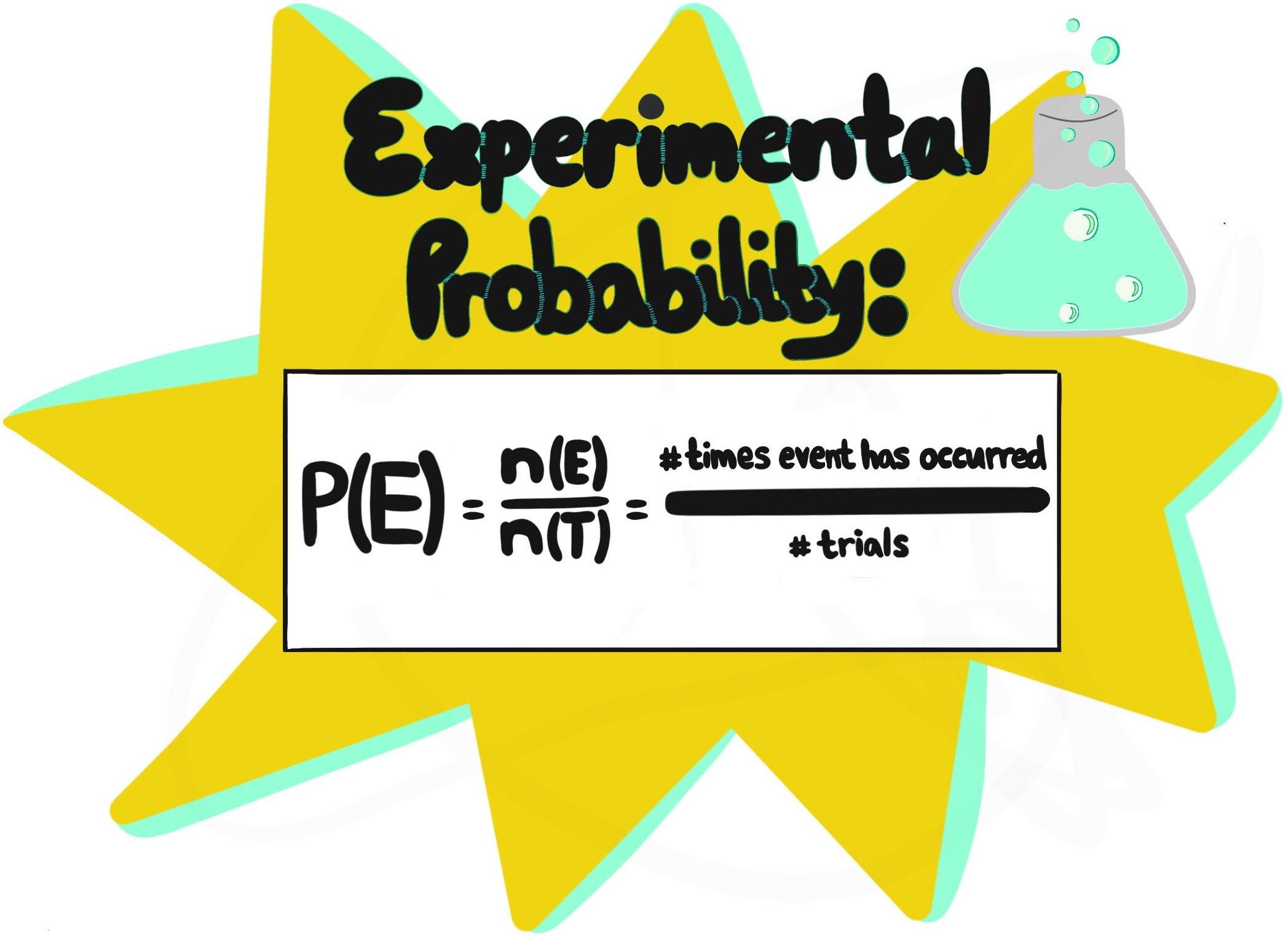
Image by Caroline Kulczycky
Here, represents the experimental probability that event will happen, represents the number of times has already occurred, and represents the total number of trials you have performed in your experiment.
Let's use this formula in an example!
You flip a coin times, and it lands on heads of those times. What is the experimental probability that the next flip is tails?
We can tackle this problem in steps. Let be the event that the coin lands on tails. We are trying to calculate the experimental probability that the coin will land on tails on the next flip.
First, let's figure out the number of trials you have conducted. Since you have already flipped the coin times, you have conducted trials, and recorded the data from these trials. Thus
Now, let's find the number of times event has occurred. You know that you landed on heads times out of the flips. Thus, you landed on tails times out of the flips. So,
Now that we have and we can substitute this information into our experimental probability formula!
Thus, the experimental probability of our next coin flip landing on tails is Notice that the experimental probability of the coin landing on tails is different than the theoretical probability of the same coin landing on tails, which is Sometimes experimental and theoretical probability match up, and sometimes they don't!
Let's do one more example of how to calculate experimental probability.
You have a bag filled with marbles whose colors are either black, white, gold, or silver. You pull a marble out at random, and it is silver. You put that marble back into the bag and repeat the process more times, drawing a silver marble of those times. What is the experimental probability of drawing a silver marble if you repeat the process once more?
Let's figure out and so we can substitute them into our experimental probability equation!
We drew a silver marble once, and then we repeated the process more times. Thus, we performed trials in total. So,
We drew a silver marble once, and then we drew a silver marble 13 more times. Thus, we drew a silver marble times in total. So,
Now we can substitute and into our experimental probability formula:
Thus, the experimental probability of drawing silver on our next turn is
It's worth mentioning that we cannot calculate the theoretical probability of drawing silver. The formula for theoretical probability, depends on how many silvers there are in the bag (number of favorable outcomes) and the total amount of marbles in the bag (number of possible outcomes). Since we don't have this information, we cannot determine the theoretical probability of drawing silver on our next turn.