Що таке енергія?

Interactive · 1 question

Photograph of a fireworks show

Image source: By Riccardo Pesce CC BY 2.0, via Wikimedia Commons

Matter is defined as anything that takes up space and has a mass. What about light? Or heat? We interact with those things daily, but they aren't matter. What are they? The answer is energy.

Energy can be split into two categories- potential energy and kinetic energy.

Kinetic energy is the energy of anything that is moving. When you are running, or walking, or chewing potato chips, you have a kinetic energy level. Even when you're sleeping, the inside of your body never stops moving. In fact, nothing ever does- atoms vibrate and move past each other constantly. We even have a sense that detects their movement. Don't believe me? We call the kinetic energy from this microscopic motion of particles heat. Light and sound are also types of kinetic energy, because they are types of waves, or repeated movement.

Potential energy is the stored energy that can be turned into motion. In order to run, or walk, or chew potato chips, or even keep your molecules vibrating at the average human body temperature, you need to eat food, which contains potential energy in the form of chemical energy. When you are high up on a hill, you have a type of potential energy called gravitational potential energy that allows you to roll down the hill without using any of your own energy.

Of course, energy is never really used- it's just converted from one form to another, according to Law of Conservation of Energy. A lot of this energy conversion occurs through chemical reactions, which is why chemistry is sometimes known as the Science of Energy in addition to the Science of Matter.

What happens to your gravitational potential energy when you jump off a swingset?

Choose one answer

Interactive · 2 questions

You probably already have an intuitive understanding of what energy is. Imagine you just finished a marathon. You are absolutely winded, you can't stop panting, you feel like you can barely even stand. You are completely out of energy and feel like you can't do anything.

In science, energy is defined in much the same manner. Energy is the ability to do work. Work is a force being exerted over some distance. Thinking back to the marathon, with every stride you take you exert a force against the ground over some distance. This means with every stride you take, you are doing work, and thus spending energy. In science we define two types of energy: kinetic energy and potential energy.

Kinetic energy is the energy of motion. If it has mass, and it is moving, then it has kinetic energy. The runner in the marathon has kinetic energy, as does a thrown baseball, or a car on the highway. A house, on the other hand, does not have kinetic energy since it is not moving.

Potential energy is energy that is stored in some manner. Think about a ball perched precariously on a hill.

A ball perched precariously on a hill

This ball might fall off the hill at any moment. And when the ball does fall, it will gain a lot of kinetic energy. This kinetic energy must come from somewhere, though, since energy is never created nor destroyed. What happens is that the kinetic energy can be converted from the potential energy that the ball has on top of the hill. When the ball is on top of the hill it has a lot of potential energy, it has the potential do work. This is an example of what is called gravitational potential energy. There are other types of potential energy as well. Charged particles can have electrical potential energy (often called voltage), and when a bow is drawn to fire an arrow it has elastic potential energy. Chemicals have chemical potential energy (sometimes referred to as chemical energy) which is stored in chemical bonds. When chemicals react with each other they use this chemical potential energy.

Two objects of equal mass are hanging from a high ceiling. One of the objects is 1 meter off the ground. The other object is 3 meters off the ground. Which object has more potential energy?

Choose one answer

Interactive · 1 question

Energy is the ability to do work. No, I'm not talking about your job! Work is the application of a force to move an object in the direction of the force. When you do work on an object, you're transferring energy from one object to another. Now, the cool thing about energy is that the total energy that exists cannot be destroyed. New energy cannot be created. It can only be transformed into another type of energy!

There are two types of energy: kinetic and potential. These two can be subdivided into many more categories, like electrical energy or nuclear energy. Kinetic energy is the energy of motion, and potential energy is based on the position of an object. Say you're on the top of a building, and you have two soccer balls. You put one next to you, then you drop the other one off the roof. Now, the one that was dropped has kinetic energy as it is falling down (and maybe hitting some poor guy in the head). But the one that is sitting right next to you has more potential energy.

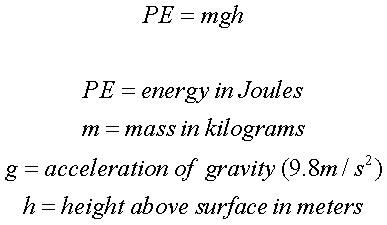
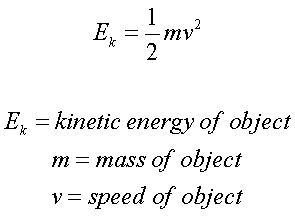
There are two main formulas you should know relating to energy.

This is the formula for potential energy:

And this is the formula for kinetic energy:

Try a practice problem!

Spongebob takes a 2 kg book from his shelf that is 1 m above the floor. What is the potential energy of the book in respect to the floor? Round your answer to the tenth.

Choose one answer

Video

(Video) Energy & Chemistry: Crash Course Chemistry

by CrashCourse

In this video, Hank from Crash Course talks about a lot of important concepts like potential energy, work, heat, and energy transfer.

Type a concept, like “slope” or “photosynthesis”.

↑ ↓ to choose · Enter to openSearch explanations and problems