বিন্যাসের সংকেত

Interactive · 2 questions

কোন nn সংখ্যক বস্তুকে rr সংখ্যক জায়গাতে কতভাবে রাখা যায়? আমরা জানি, এই প্রশ্নের উত্তর হলো,

Choose all correct answers

Interactive · 7 questions

Finding Permutations

When working with permutations, the first thing to know is that they are different from combinations.

With combinations, order doesn't matter. Jaya, Zach, and Marlee is the same as Zach, Marlee, and Jaya. Either way, it's the same combination of people.

With permutations on the other hand, order matters. Jaya, Zach, and Marlee is a totally different permutation than Marlee, Jaya, and Zach.

Permutations show us how many possible ways there are do something.

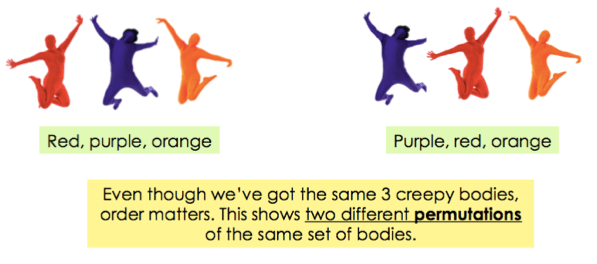
The first arrangement of bodies is in the order red, purple, orange. The second is in the order purple, red, orange. Even though we've got the same 3 creepy bodies, order matters. This shows two different permutations of the same set of bodies.

Here's another example, based on a joke that math teachers like to tell:

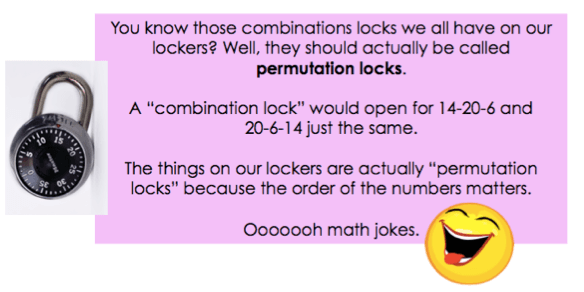
You know those combination locks we all have on our lockers. Well, they should actually be called permutation locks. A "combination lock" would open for 14-20-6 and 20-6-14 just the same. The things on our lockers are actually "permutation locks" because the order of the numbers matters.

Let's try a practice problem to see how we can calculate permutations.

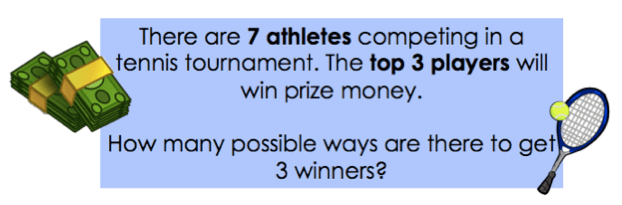
There are 7 athletes competing in a tennis tournament. The top 3 players will win prize money. How many possible ways are there to get 3 winners?

To answer this question, we need to calculate how many permutations there are for the top 3 players given that we have 7 players overall. Remember, order matters.

Here's the general formula for calculating permutations: nPr=n!(n−r)!_nP_r = \frac{n!}{(n-r)!}

  • PP stands for permutation.
  • nn is the number of people or objects to choose from.
  • rr is the number of spaces to fill.
  • The !!s in this equation don't mean that you need to read it really loudly. In math, exclamation points are the symbol for factorials.

To find a factorial, multiply the number before the exclamation point by every number less than it, all the way down to 1.

For example: 5!=5⋅4⋅3⋅2⋅1=120\begin{align}5! &= 5\cdot 4\cdot 3\cdot 2\cdot 1 \\ &= 120\end{align}

Let's practice factorials before we bring our focus back to permutations.

What is 6!6!?

Choose one answer

Illustrated · 1 min

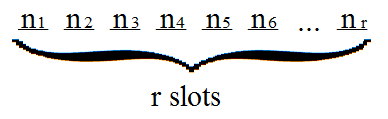
A permutation tells you how many ways you can arrange nn things in rr slots.

The items n_1, n_2, ..., n_r take up r slots.

The formula for finding how many permutations there are is: n!(n−r)!\boxed{\frac{n!}{(n-r)!}} Remember, n!=n⋅(n−1)!⋅(n−2)!⋅(n−3)!⋯1n!=n\cdot (n-1)!\cdot (n-2)!\cdot (n-3)!\cdots 1. If we look at this with an example, it will become clear the easiest way to calculate this. n=9,    r=3    →    9!(9−6)!    →    9⋅8⋅7⋅6⋅5⋅4⋅3⋅2⋅16⋅5⋅4⋅3⋅2⋅1n=9,\;\;r=3\;\;\rightarrow\;\; \frac{9!}{(9-6)!}\;\;\rightarrow\;\; \frac{9\cdot8\cdot7\cdot\color{Red} {6\cdot5\cdot4\cdot3\cdot2\cdot1}} {\color{Red}{6\cdot5\cdot4\cdot3\cdot2\cdot1}} All the numbers in red cancel out with each other. This means that the expression simply turns into: 9⋅8⋅7=5049\cdot8\cdot7 = 504 Instead of writing out that big fraction every time, we have a notation for this. Permutation Notation is: nPr_nP_r So with the example above it would be: 9P3=9!(9−6)!=9⋅8⋅7=504_9P_3=\frac{9!}{(9-6)!}=9\cdot8\cdot7 = 504 For Permutation notation, nn is always the bigger number and rr is the smaller number. If rr is equal to nn, then in the denominator you get (n−n)!    →    0!(n-n)!\;\;\rightarrow\;\;0!. To make sense of this, 0!=10! =1. That means, if: n=r,    nPn=n!n=r,\;\; _nP_n=n! This makes sense because arranging nn things into nn slots is the same as arranging nn things in as many orders as you can, which is exactly what n!n! does.

Interactive · 1 question

PERMUTATIONS

Permutations are used when you want to find how many different groups of things you can create out of a larger set of things, but the order matters. The easiest way to show what exactly you are looking for in a permutation is called Permutation Notation and looks like this: nPr_n P_r where nn is the number of objects you have in the entire set, and rr is the number of objects in each ordered group you are trying to find. In all cases, nn will always be the larger of the two numbers as it is the group that you are picking elements from. The equation for calculating the number of permutations is as follows: nPr=n!(n−r)!_n P_r=\frac{n!}{\left(n-r\right)!} We’re just going to dive right into a problem in order to learn how to use this equation.

Let’s say that there is a local race track that has weekly auto races with 1010 people in each race. Each person that places in 5th place or higher earns points that go towards their standings for the entire season, with the higher placing racers getting more points. In any given race, how many different permutations of point-earning racers would there be?

First, you have to decide which number is nn and which is rr. Here, n=10n = 10 as that is the total number of racers, and r=5r = 5, as that is the number of racers that can score points in each race. The equation would look like this with the numbers plugged in: 10P5=10!(10−5)!=10!5!_{10} P_5=\frac{10!}{(10-5)!}=\frac{10!}{5!} To solve this, you can’t just just divide 10 by 5, then take the factorial. However, you also don’t need to find each factorial individually before you divide the numbers. You can cancel out factors that are in both the numerator and denominator. In this case, its (5⋅4⋅3⋅2⋅1)(5\cdot4\cdot3\cdot2\cdot1). 10!5!=10⋅9⋅8⋅7⋅6⋅5⋅4⋅3⋅2⋅15⋅4⋅3⋅2⋅1=10⋅9⋅8⋅7⋅6=30,240.\begin{align}\frac{10!}{5!}&=\frac{10\cdot9\cdot8\cdot7\cdot6\cdot5\cdot4\cdot3\cdot2\cdot1}{5\cdot4\cdot3\cdot2\cdot1}\\ &=10\cdot9\cdot8\cdot7\cdot6 \\ &=\boxed{30{,}240}.\end{align}

If you're still a little uncomfortable with the idea, here is a video that goes over both Permutations and Combinations in depth by Brandon Foltz on YouTube.

On a baseball team there are 99 batters. A team's coach is trying to decide who is going to be batting first, second and third. How many different ways could he pick each of his 99 batters?

Choose one answer

Type a concept, like “slope” or “photosynthesis”.

↑ ↓ to choose · Enter to openSearch explanations and problems