Interactive · 2 questions

+2 contributors

Theoretical probability is just what it sounds like: the probability of an event occurring in theory. In other words, when you calculate theoretical probability, you are calculating a hypothetical or expected value. You are not calculating probability based on experimentally collected data (that would be Experimental Probability rather than Theoretical Probability).
We can calculate theoretical probability of an event, occurring using the following formula:
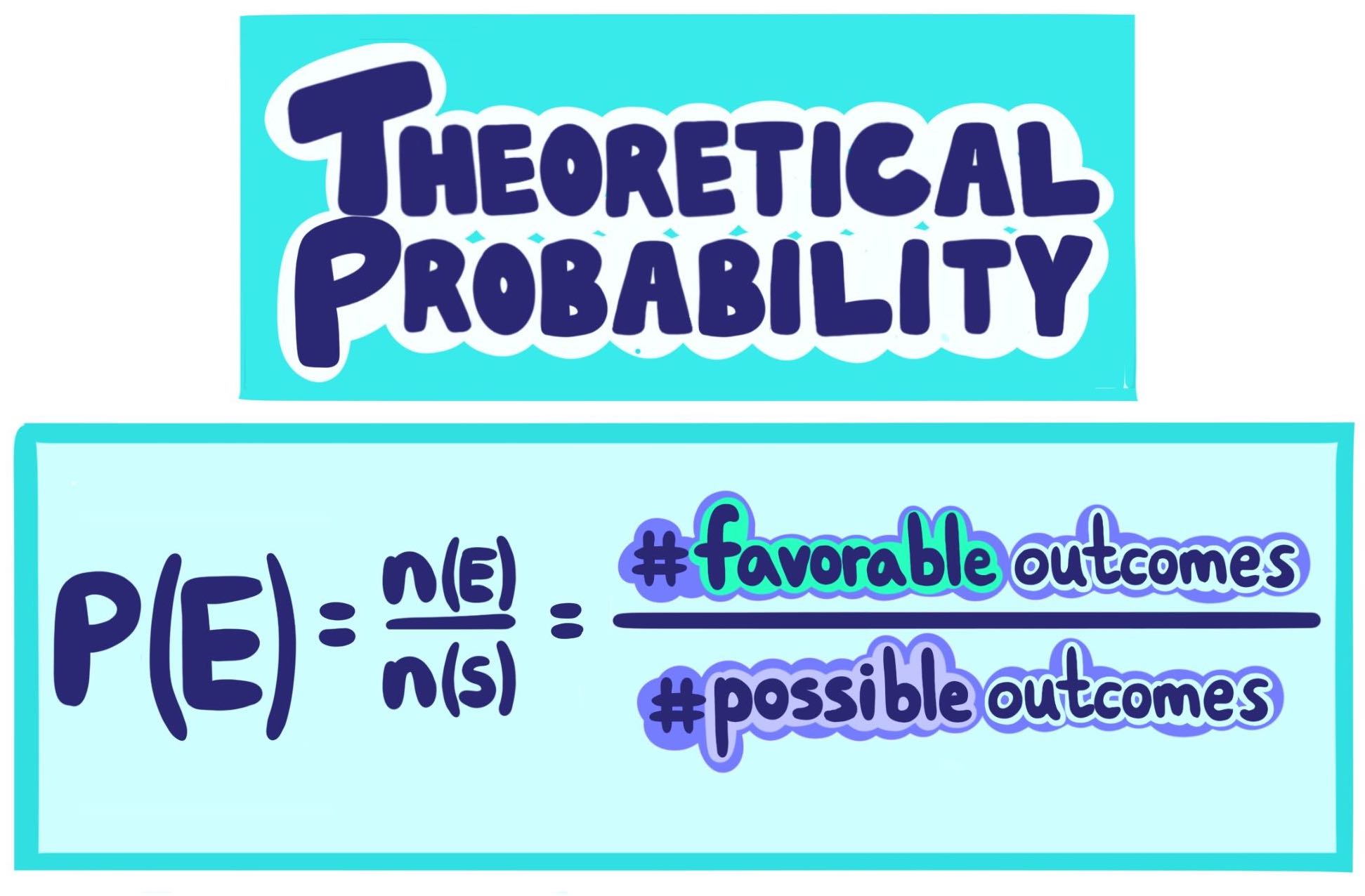
Image by Caroline Kulczycky
Here, represents the theoretical probability that event will happen, represents the number of times can occur, and represents the total number of outcomes.
Let's use this formula in an example!

Image by rawpixel.com via Pexels CC0
You have a bag with ten marbles. Half of the marbles are blue, two are purple, one is green, the rest are pink. If you reach into the bag and pull out a marble at random, what is the theoretical probability that it will be pink?
We can tackle this problem in steps. First, let's figure out the number of possible outcomes. Since there are ten marbles in the bag, the total number of marbles that you are going to be pulling from is ten. Thus
Now, let's find the number of favorable outcomes. represents the number of pink marbles there are in the bag. To calculate the number of pink marbles, we simply subtract the number of blue, purple, and green marbles from the total number of marbles:
There are a total number of marbles. Half of the marbles are blue. Thus marbles are blue. We know that marbles are purple and marble is green. So,
Now that we have calculated and we can substitute this information into our theoretical probability formula!
Thus, the theoretical probability of choosing a pink marble from the bag is
In this same scenario, what is the theoretical probability of pulling out a green marble?
We already know that the total number of marbles, is Since there is only one green marble, we know that Thus,
Thus, the theoretical probability of choosing a green marble is
It is important to note that, if you drew a marble out of the bag, made a note of what color it was, put it back into the bag, shuffled the bag, and repeated this process multiple times, the actual amount of times you choose a certain color may not correspond to the theoretical probability of pulling that color. For example, you may pull a marble out of the bag five times, and you could pull out a green marble all five times. Theoretical probability does not tell you what will definitely happen in practice it just gives you an expected value.